
The science
of threshold
navigation
Liminal Fluency™ - A natural human process discovered over 100 years ago. Buried by the modern world. Recovered, compressed and operationalised into a navigation system you can actually use
The Lost Art
What we forgot
For most of human history, transitions were bounded. You moved from one state to another. There were rituals. Elders. Containers for the crossing. The in-between was structured, witnessed, temporary.
We traded that for productivity, linear careers, long-term plans and constant self-optimisation. We became allergic to uncertainty and impatient with the in-between. We demand certainty, preditability and, above all, control.
The result: Transitions that used to be guided are now navigated alone. Liminality, what used to be an occasional phase, has become a chronic condition. But we have lost the language to name it, let alone move through it. This is what Liminal Fluency™ recovers.

A century of research
Arnold van Gennep · 1909
The French anthropologist who first identified the universal three-phase structure underneath every meaningful transition: Separation → Liminality → Incorporation. He showed that across cultures, all transitions follow the same shape. And that the middle phase is not a void but a threshold.
Victor Turner · 1960s
The cultural anthropologist who liberated liminality from ritual. He reframed the in-between not as empty space but as a realm of pure possibility – disorienting, generative, dangerous. The phase most people want to skip is the one where transformation actually happens.
William Bridges · 1980s
The organisational psychologist who translated the anthropology into modern terms. He drew the distinction now central to every serious transformation programme: change is external, the event. Transition is internal, what happens inside the people living through it.
The architecture has held for over a century. Yet the practice went missing somewhere between Agile and always-on. Liminal Fluency™ brings it back - for an era that has never needed it more.

The Transition Debt
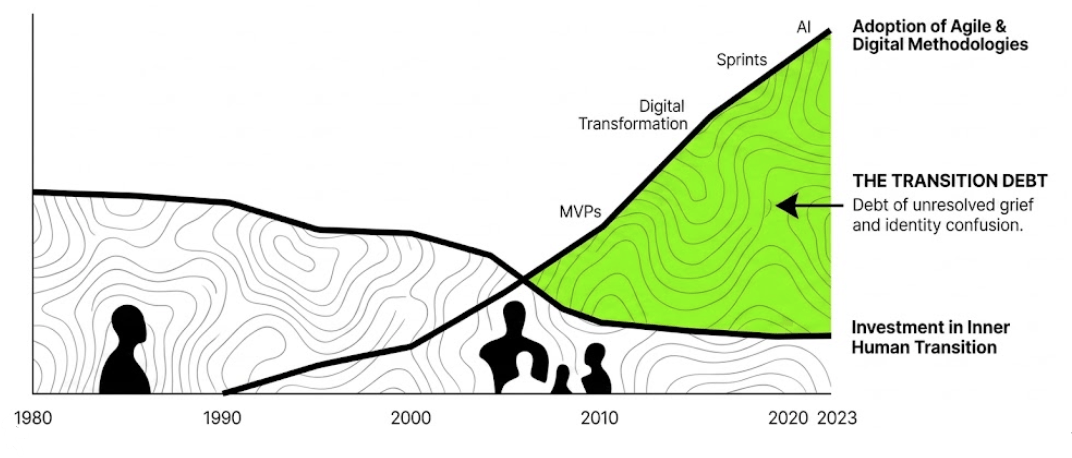
From the 1980s onwards, organisations got dramatically better at speed. Lean. Six Sigma. Agile. Digital transformation. AI. Each wave added optimisation, velocity and adoption metrics. What did not scale alongside it was investment in human transition capacity. The slower, harder, less measurable work of helping people actually move through what these changes asked of them.
Each uncompleted transition leaves behind unfinished business. Unresolved grief. Identity confusion that did not get the time to integrate. And like financial debt, the cost compounds. Each new change initiative arrives before the last transition has been processed. The accumulated load eventually surfaces as burnout, change fatigue or quiet quitting. Structurally, it is something else: people in a state of readiness to grieve, where even minor changes trigger outsized reactions.
The Architecture
Three movements. Six stages. Six trainable capacities. Six ways it shows up.
Most thinkers refer to the originally discovered three stages of transition. Yet, every transition is more granular, there is simply much more happening underneath. Therefore, Liminal Fluency™ goes further. Each phase has been broken into the developmental stages people actually live through. Each stage are mapped to the specific capacities required to move through it. That granularity is what makes the framework operational, not just descriptive.
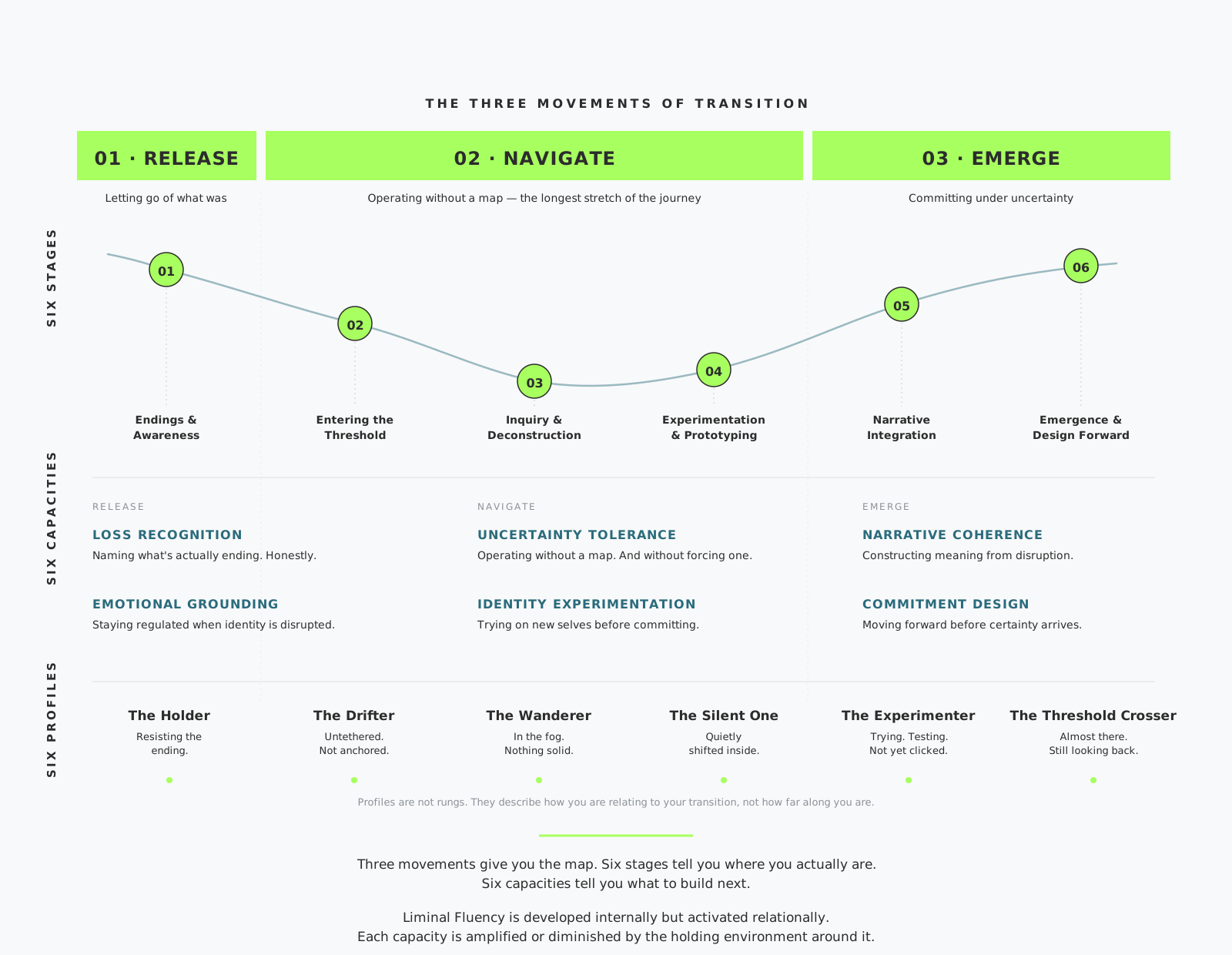
These movements rarely happen in sequence. They dial up and down. Most people recognise themselves in all three at once, cycling through them, sometimes in a single week. That is not confusion. That is an honest transition. The Diagnostic identifies where your capacities currently stand, and which profile is showing up in you right now. The next conversation is about what you build next, and the holding environment around it that lets the work actually happen.
A natural human process discovered over 100 years ago. Buried by the modern world. Operationalised for the era we are actually in.
Whether you are navigating your own transition, leading others through one, or building an organisation that can hold both, the work starts with the same question:
Where do you currently stand?