This time, the technology can replace the people adopting it
Liminal Fluency™ is a framework for leaders and organisations navigating identity-disrupting change at scale.
Built on 100+ years of research.
We are living inside a threshold. The planet is at limits. Consumer behaviours are shifting faster than industries can adapt.
And AI is challenging everything - business models, roles, even the meaning of human contribution.
Yet, most organisations respond with old models built for a world that no longer exists. Adoption KPIs. PMO in charge of AI rollout. Change management with schedules. Without challenging themselves, their business model or the way they actually work.
The result? 70% of transformation programmes fail. Employee willingness to support change dropped by 36%. Not because of the strategy or intentions. But because the human side of change was managed but not helped to navigate through.
Change is not Transition
We have been here before. And we got it wrong.
Agile. Scrum. Digital transformation. AI. The methodology & technology has changed, but the assumption that people adapt when being told to, hasn't. And they don't, they transition - on their own terms.
We treated transformation as a tooling problem, optimised adoption metrics, trained on new systems and declared success when technical milestones were reached. What we didn't address was the human layer underneath: Roles redefined, expertise devalued, familiar structures were lost, identity disrupted.
Organisational psychologist William Bridges drew this distinction decades ago. Change is external: the event, the restructure, the deployment. Transition is the inner psychological process that makes the change work. Change starts with an outcome. Transition starts with an ending.
And it requires people to let go of one professional self before they can function fully in the next. The result: New structures with old behaviours. Technically complete transformations that never hold.
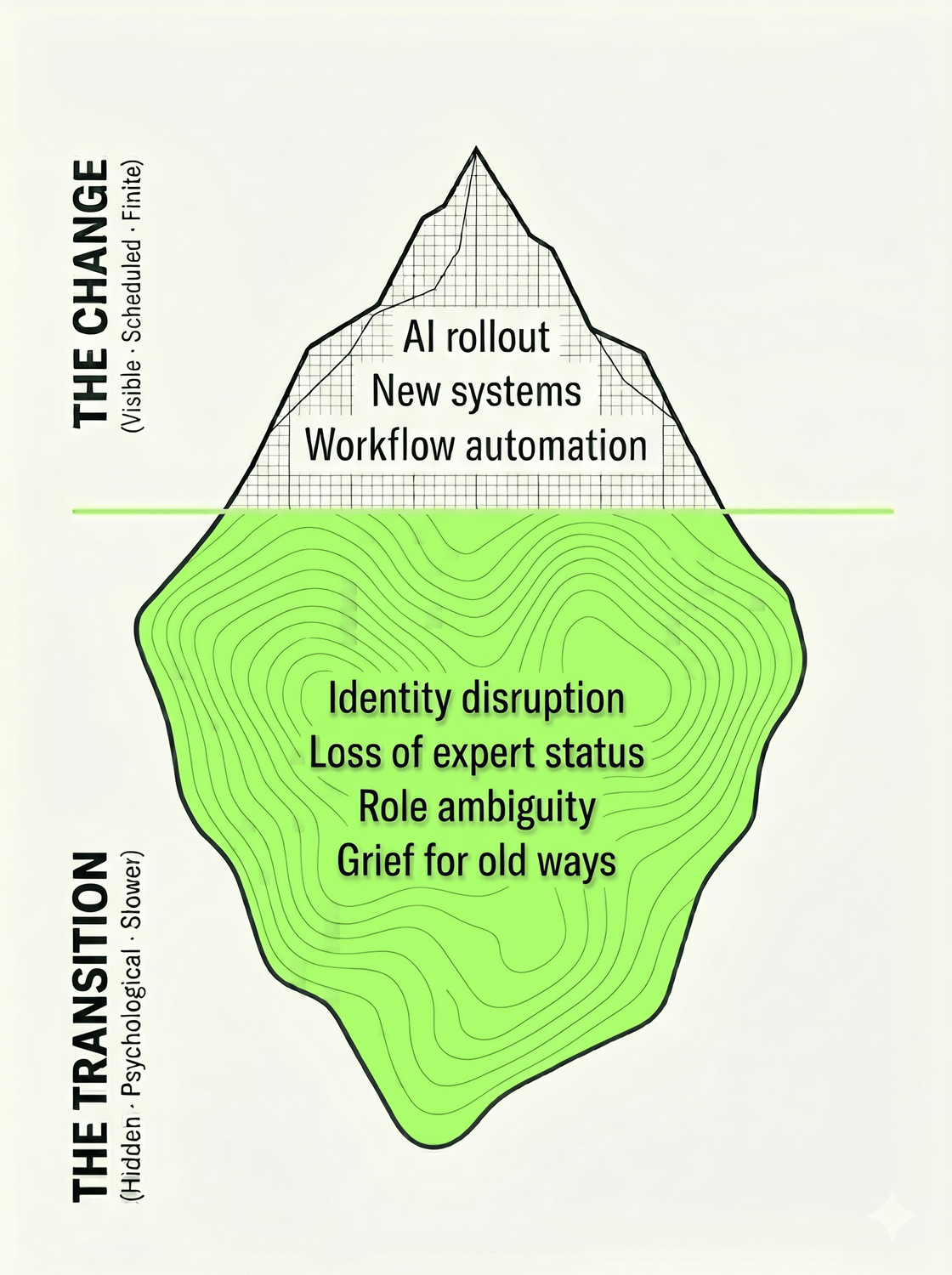
The stakes are bigger this time
AI is not a software upgrade or technology roll-out. The stakes are much higher.
AI redefines competence and identity itself. This time, the technology has the potential to replace the very people who are supposed to adopt it. Some of them sense it and quietely prepare. And every step towards automation they actively help further accelerates that reality.
Most organisations are running AI as a productivity programme. Faster outputs, leaner teams, efficiency gains. But two questions sit underneath every AI rollout, and almost nobody is asking them.
Who are our people becoming when their expertise is redefined overnight? And what is the business actually for, once productivity and efficiency are commoditised?
Change management was never built to answer either question.
Core Business models are at risk

Most companies treat AI as something to add onto what already exists. A tool on top of the current architecture. A faster, more efficient way to do what is done today and what was done in the past.
This could prove to be a very expensive mistake that has the potential to eliminate the entire existence of your organisation. AI doesn't just threaten how your people see themselves. It threatens how your organisation defines itself. What you sell. How you create value. What it is that only you own or only you can do? What your brand actually stands for when the thing that used to differentiate you can be replicated by anyone with the right tools.
Most companies are designed like machines, built for efficient, predictable outcomes, standardisation, coordination and control. That model rewarded staying the same, just faster, leaner. AI rewards something else entirely: Organisations willing to question their own business model and role before the market does it for them.
Ask yourself honestly:
Are you using AI to summarise meetings or are you questioning why the meeting needed to happen at all? Are you using Copilot to draft the strategy deck faster or are letting AI challenge the entire strategy itself? Or, how many new business opportunities have you identified using AI?
If you are not already questioning your entire business model, your ways of working and what you actually stand for, you will be behind very soon.
That's where this work actually starts. Not with a simple rollout plan, but with the harder, yet more valuable questions. Then we help building the capacity to navigate and act upon these changes once you've answered it using our proprietary framework.
What we build
Liminal Fluency™ is the organisational capacity to recognise, inhabit and navigate the spaces between what was and what will be - without losing people, momentum or identity in the process.
It is not a replacement for change management. It is what makes change management actually work. A trainable, scalable organisational capability. Not a mindset programme. Not a resilience module. Three capabilities it develops:
01.
Transition Literacy
Leaders who can read where their people actually are in a transition, not where the project plan says they should be. Who understands the difference between resistance and disorientation.
02.
Liminal Leadership
The ability to hold direction without forcing premature resolution. Leading when the map is still forming. Creating conditions where not-knowing is allowed, because that's where adaptation begins.
03.
Identity Navigation
Guiding teams through identity disruption. Building the capacity to carry the dual load: Performing the new while processing the loss of the old, without drop in productivity, retention or engagement.
We help your people navigate the transitions your decisions create
When this matters
AI and Technology Transformation
The licenses are paid and deployment seems on schedule. Yet, adoption isn't. People mostly use AI for the basics. Nobody is asking what it means for roles, identity or how your organisation actually works.
Restructuring and Workforce Transition
The new org chart is live. Teams are technically in place, but functionally stuck. Morale is lower than the plan predicted. Structure changed, identities haven't caught up.
Change Management Augmentation
Your change function is in place. The process is well designed and scheduled. Communication plan is in place. But progress is slower than expected and the usual levers aren't working.
Strategic
Pivots
The business model and competitive landscape is changing. The organisational identity hasn't caught up and people haven't internalised the changes
made.
Three ways in
Strategic Advisory
For leadership teams who need clarity on what's actually happening underneath their transformation. Diagnosis, framework, direction. Works standalone or alongside your existing change function.
Capacity Building
Transition Literacy for HR, change managers and leadership teams. Practical Workshops and Sessions. Building the internal capacity to navigate what's coming, not just manage what's happening already.
Embedded Leadership
Fractional transition leadership.
1-3 days per week. Clear change mandate and transformation accountability from within.
For when the transformation is too complex or moving too fast for internal capacity alone
Why me
20+ years navigating pivotal transitions across automotive, retail, consumer goods and sustainability. Award-winning strategist and certified change manager.
I've worked inside organisations and alongside them. That combination matters: the people inside the system often can't see what someone at the boundary can. And someone who has never been inside can't feel what the people are actually going through.
Built my own business. A sustainable retail venture. Nominated twice for Germany's most prestigious sustainability award. Then closed. That taught me more about what organisations go through during transition than any framework ever could.
One head, many hats. That's me. That's your advantage

Follow me on LinkedIn
Technical capability will be commoditised. Transition capacity will not. Organisations that build it will endure. Most transformation programmes manage the visible part. The invisible part – where identity, trust and capability actually shift – is where it succeeds or fails. That's where I work.